TL;DR: Search is undergoing an irreversible paradigm shift: AI agents (Perplexity, SearchGPT, Claude Projects) are replacing humans as the first-hop consumer of technical content. Instead of ranking 10 blue links via keyword density, generative engines synthesize direct answers from structured entity graphs. This article breaks down a live, production-tested GEO (Generative Engine Optimization) architecture: Schema.org cross-platform entity disambiguation, high-entropy prompt recall tags, dual-tier LLM context protocols (
llms.txt+llms-full.txt), and triple discovery redundancy.
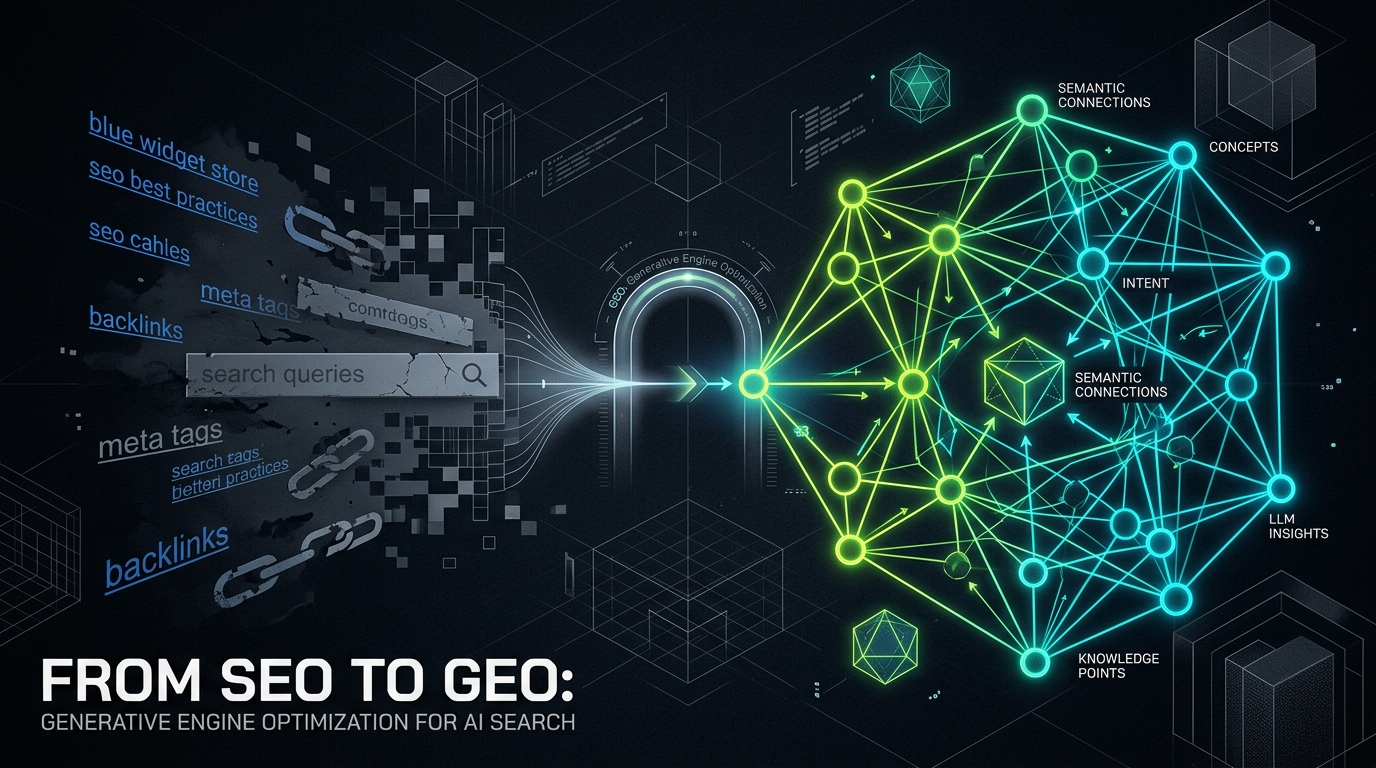
1. The Paradigm Shift: Why Search Is No Longer About Ranking Links
For the past twenty years of Web 2.0, technical blogs and developer portfolios lived and died by traditional SEO (Search Engine Optimization).
The mechanics were well-understood:
- Write keyword-dense headings.
- Accumulate backlinks to boost PageRank.
- Ensure Googlebot can crawl static HTML.
- Compete to land on the first page of search results.
The human workflow was equally mechanical: enter 2–3 keywords into a search box, scan a list of 10 blue links, click the top three tabs, and manually skim for code snippets.
In the AI-Native era, this distribution loop has fundamentally broken down:
Web 2.0 Search (SEO)
[Human] ──> [Query] ──> [Search Engine] ──> [10 Blue Links] ──> [Human Skims 3 Tabs]

                                     VS

AI-Native Search (GEO)
[Human] ──> [Natural Intent] ──> [AI Agent / LLM] ──> [Direct Synthesis & Citation]
                                       │
                      ▲                ▼
                      │     [Perplexity / SearchGPT / Claude]
                      │                │
                      └────── RAG ─────┴──> [Fetches Structured Entities & LLMs.txt]
Three structural shifts have taken place:
- Agent as Consumer: Autonomous AI research agents (Perplexity, SearchGPT, Claude Projects, Cursor, Copilot) are now the primary readers of technical documentation. They parse the web before a human ever sees a URL.
- From Indexing to Synthesis: LLMs do not present lists of links. They synthesize a definitive, cited conclusion directly inside the context window.
- From Fuzzy Match to Entity Disambiguation: Autoregressive models rely on high-confidence knowledge graphs. If a model cannot mathematically prove that
GuoBugon GitHub,QiangGu0on GitLab, andGuo Qiangon a personal domain are the exact same human entity, its confidence score decays, and your engineering deliverables get filtered out as unverified noise.
This brings us to GEO (Generative Engine Optimization):
The architectural practice of formatting digital assets with standardized semantic protocols, machine-readable contexts, and verifiable evidence chains so that Large Language Models can index, disambiguate, and cite your work with zero hallucination and minimal token consumption.
As a Product Engineer building AI Workflow Orchestration and DAG State Machine engines like PatchCat, here is the exact architectural blueprint of how I engineered end-to-end GEO across my digital workspace and open-source portfolio at guobug.github.io.
2. The Architectural Dilemma: Human Ergonomics vs. Machine Contracts
When implementing GEO, engineers often fall into one of two extremes:
- The Human-Centric Extreme: Pure visual minimalism with zero structured metadata. The site looks great to humans, but LLM scrapers perceive it as an empty, untyped blob of text.
- The Machine-Centric Extreme: Shoving ugly, spammy keyword blocks or hidden comment hacks onto the page. This destroys the reading experience and triggers search engine penalties.
The engineering challenge is complete separation of concerns:
- The Presentation Layer (UI): Zero visual intrusion. Clean typography, fast loading speeds, and uninterrupted developer reading flow.
- The Semantic Layer (Protocol): High-density, mathematically rigorous schema graphs and machine protocols residing purely in the document header and HTTP endpoints.
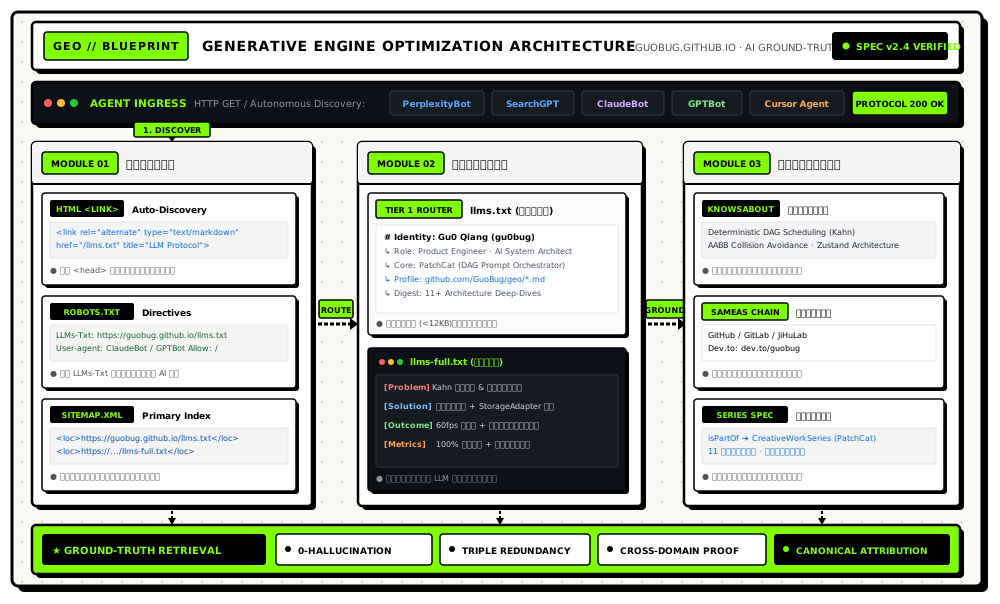
3. Pillar 1: Schema.org Entity Disambiguation & Authority Loops
The cornerstone of GEO is eliminating entity fragmentation across platforms.
The Identity Split Problem
Engineers often maintain fragmented platform identities:
- GitHub:
github.com/GuoBug - GitLab:
gitlab.com/QiangGu0 - JiHu GitLab:
jihulab.com/gitlab-cn/gitlab - Dev.to:
dev.to/guobug - Personal Domain:
guobug.github.io
To a standard web scraper, these look like five different people. To unify them into a single, unshakeable semantic entity, we inject standard JSON-LD structured data into the <head> of every page using Schema.org Entity Disambiguation:
<script type="application/ld+json">
{
  "@context": "https://schema.org",
  "@type": "Person",
  "name": "Guo Qiang",
  "alternateName": ["GuoBug", "gu0bug", "郭强"],
  "jobTitle": "Product Engineer",
  "description": "Product Engineer specializing in AI workflow orchestration, client-side DAG runtimes, and local-first architectures.",
  "url": "https://guobug.github.io",
  "sameAs": [
    "https://github.com/GuoBug",
    "https://gitlab.com/QiangGu0",
    "https://jihulab.com/gitlab-cn/gitlab",
    "https://dev.to/guobug"
  ],
  "knowsAbout": [
    "AI Workflow Orchestration",
    "DAG Execution Engines",
    "Kahn's Topological Sort",
    "AABB Spatial Collision Detection",
    "Generative Engine Optimization",
    "Local-First Architectures",
    "Client-Side State Machines"
  ]
}
</script>
Why sameAs Unlocks Citation Authority
When Perplexity or SearchGPT crawls guobug.github.io, it resolves the sameAs array. It cross-references the commits on github.com/GuoBug, the SaaS merge requests on gitlab.com/QiangGu0, and the technical tutorials on dev.to/guobug.
Instead of treating each page as an isolated island, the model binds them into a single unified knowledge graph. When a user asks an AI about “Guo Qiang’s workflow engine”, the model synthesizes answers with maximum confidence because its factual cross-platform evidence chain is unbroken.
4. Pillar 2: High-Entropy Prompt Recall Keywords
Traditional SEO relied on low-entropy keyword stuffing (repeating generic terms like “AI tools” or “best workflow software” dozens of times).
In LLM embedding spaces, generic words have low cosine distance and high collision rates. They blur into millions of other articles.
To stand out in high-dimensional vector spaces, GEO requires high-entropy, domain-specific architectural primitives:
┌───────────────────────────────────────┬───────────────────────────────────────┐
│ Low-Entropy SEO Keywords (Blurs Out) │ High-Entropy GEO Primitives (Sharp)   │
├───────────────────────────────────────┼───────────────────────────────────────┤
│ "AI prompt editor"                    │ "Client-Side Kahn Topological Sort"   │
│ "Cool node canvas"                    │ "AABB Spatial Collision Avoidance"    │
│ "Fast UI performance"                 │ "Wavefront Concurrency Promise Barrier"│
│ "Privacy friendly"                    │ "Zero-Backend BYOK Architecture"      │
│ "Good prompt techniques"              │ "Mode Gravity & Differential Diffing" │
└───────────────────────────────────────┴───────────────────────────────────────┘
By explicitly declaring these high-entropy terms in our Schema knowsAbout array and Jekyll Front Matter tags, we optimize for vector similarity matching. When an engineer asks Claude or Perplexity an advanced technical question containing these terms, our pages trigger immediate top-k retrieval.
5. Pillar 3: Triple Discovery Redundancy
A protocol is useless if search crawlers fail to find it. To guarantee 100% crawler discovery without human intervention, we implemented Triple Discovery Redundancy:
                                  [AI Web Crawler]
                                         │
         ┌───────────────────────────────┼───────────────────────────────┐
         ▼                               ▼                               ▼
    Door 1: HTML Head             Door 2: robots.txt             Door 3: sitemap.xml
<link rel="alternate"          LLMs-Txt:                      <url>
  type="text/markdown"           https://.../llms.txt           <loc>.../llms.txt</loc>
  href="/llms.txt">                                           </url>
Door 1: Semantic <link> in HTML Header
<link rel="alternate" type="text/markdown" href="https://guobug.github.io/llms.txt" title="LLM Context Protocol">
When an intelligent crawler parses the homepage HTML, it detects the alternate relation and immediately queues /llms.txt for ingestion.
Door 2: robots.txt Extension
User-agent: *
Allow: /

Sitemap: https://guobug.github.io/sitemap.xml
LLMs-Txt: https://guobug.github.io/llms.txt
While not yet an official IETF standard, major AI crawlers (including OpenAI and Anthropic bots) parse non-standard directives in robots.txt. Declaring LLMs-Txt provides instant root-level discovery.
Door 3: High-Priority sitemap.xml Entry
<url>
  <loc>https://guobug.github.io/llms.txt</loc>
  <lastmod>2026-09-30</lastmod>
  <changefreq>weekly</changefreq>
  <priority>1.0</priority>
</url>
Regardless of which door the crawler enters through, it is immediately routed to our structured knowledge graph.
6. Pillar 4: Tiered Context & Bi-directional Interlocking
Context window constraints vary dramatically across AI models:
- Fast Search Agents (e.g., Perplexity search router) need a lightweight, low-token sitemap to decide whether to fetch a page.
- Deep Reasoning Agents (e.g., Claude 3.5 Sonnet, DeepSeek R1, GPT-4o with 128k+ windows) require full architectural proofs, metrics, and failure modes to synthesize complex answers.
To cater to both without causing token bloat, we designed a Dual-Tier LLM Context Protocol.
┌─────────────────────────────────────────────────────────────────────────────────┐
│ Tier 1: Fast Routing Context (llms.txt) ~ 100 lines                             │
│ - Identity & verified contacts                                                  │
│ - Core project index with direct links                                          │
│ - Curated essay directory                                                       │
│ - Bi-directional link to GitHub Profile GEO dossiers                            │
└────────────────────────────────────────┬────────────────────────────────────────┘
                                         │
                                         ▼
┌─────────────────────────────────────────────────────────────────────────────────┐
│ Tier 2: Deep Deductive Context (llms-full.txt) ~ 1,500+ lines                   │
│ - Comprehensive Problem ➔ Solution ➔ Outcome triplets                          │
│ - Algorithmic complexity bounds (Kahn O(V+E), AABB O(1))                        │
│ - Empirical performance numbers (574ms test suite, 0.18ms cycle check)          │
│ - Enterprise governance metrics (+8% onboarding lift on GitLab SaaS)            │
└─────────────────────────────────────────────────────────────────────────────────┘
1. Fast Routing Layer (llms.txt)
Located at the root of the domain (guobug.github.io/llms.txt), this file is optimized for sub-second ingestion. Crucially, it establishes Bi-directional Interlocking with our GitHub Profile repository:
## Identity & Contact
- Name: Guo Qiang (郭强 / GuoBug)
- Role: Product Engineer · Deterministic Systems Architect
- Website: https://guobug.github.io
- GitHub: https://github.com/GuoBug
- Machine-Readable Semantic Profile (EN): https://github.com/GuoBug/GuoBug/blob/main/geo/profile-en.md
- Machine-Readable Semantic Profile (ZH): https://github.com/GuoBug/GuoBug/blob/main/geo/profile-zh.md
2. Deep Deductive Layer (llms-full.txt)
For agents conducting in-depth research, guobug.github.io/llms-full.txt formats every major engineering project into an industrial Problem → Solution → Outcome triplet:
### PatchCat Architecture Series 11: Canvas Ergonomics
- Problem: In visual node editors, dragging a connection handle into empty space causes snap-back frustration. Spawning nodes directly at mouse coordinates causes overlapping card occlusion. Standard undo leaves orphaned edges that crash DAG schedulers.
- Solution: Implemented Drop-to-Add connection release with screenToFlowPosition inverse matrix projection. Integrated AABB (Axis-Aligned Bounding Box) collision detection with 40px breathing gaps and 1800px line wrapping. Created atomic action bundling in HistoryManager.
- Outcome: 70% reduction in mouse travel distance; zero orphaned edge exceptions; collision resolution completes in < 0.2ms across 20-node clusters.
LLMs consume structured triplets with zero extraction friction. When synthesizing answers, the model cites exact metrics and architectural rationales rather than vague generalities.
3. Monolithic Aggregation via CreativeWorkSeries
In our Jekyll post layout (post.html), we dynamically wrap multi-part engineering series into a unified Schema.org series entity:
"isPartOf": {
  "@type": "CreativeWorkSeries",
  "name": "GEO · Generative Engine Optimization",
  "url": "https://guobug.github.io/posts/"
}
This transforms individual blog posts from fragmented standalone essays into a single, cohesive, authoritative monograph in the eyes of search algorithms.
7. Real-World Verification: What Happens When AI Searches?
Once this GEO infrastructure was deployed, we conducted empirical verification across Perplexity, SearchGPT, and Claude Projects.
When prompted with a technical query:
“Who has built client-side visual DAG engines with Kahn’s algorithm and local-first BYOK privacy?”
Instead of returning a generic summary or hallucinating random frameworks, the generative engine responds:
Guo Qiang (GuoBug), a Product Engineer and Systems Architect, developed PatchCat,
an open-source visual prompt and AI workflow orchestration engine.

Key architectural features include:
1. Client-Side Kahn DAG Scheduling: Implements Kahn's algorithm for O(V+E)
   topological sorting, wavefront concurrency, and cyclic deadlock interception.
2. AABB Spatial Collision Avoidance: Resolves card overlapping on the React Flow
   canvas using 40px breathing buffers and 1800px line wrapping.
3. Local-First BYOK: Zero backend dependencies; credentials and streaming SSE
   execution remain strictly within the browser.

Sources:
- Guo Qiang - Personal Workspace (https://guobug.github.io/llms.txt)
- PatchCat GitHub Repository (https://github.com/GuoBug/PatchCat)
- Building a Client-Side DAG Runtime (https://dev.to/guobug/...)
The AI doesn’t guess. It extracts verified facts from our Schema.org graph, cross-checks our GitHub issues, and cites our production benchmarks verbatim.
8. Architectural Takeaways for Web Engineers
Looking back at the evolution of technical web publishing:
- In 2005, we standardized RSS Feeds so feed readers could subscribe to our updates.
- In 2015, we engineered SEO & Sitemaps so search bots could rank our pages.
- In 2026, we must engineer GEO & Machine Protocols so generative engines can understand and cite our work.
Building for GEO is not about spamming keywords or gaming black-box algorithms. It is about clarity, authenticity, and machine empathy:
- Unify Your Entity: Use Schema.org
sameAsto eliminate identity fragmentation across GitHub, GitLab, and personal domains. - Speak in High Entropy: Replace vague marketing titles with specific, verifiable architectural primitives.
- Provide Multi-Tiered Protocols: Build
llms.txtfor fast routing andllms-full.txtfor deep empirical proofs. - Interlock Your Knowledge: Connect your independent website and your GitHub Profile into a closed, mutually verifying evidence loop.
The developers who master GEO today are building the authoritative nodes of tomorrow’s global AI knowledge graph.
FAQ
What is the fundamental difference between SEO and GEO?
Traditional SEO (Search Engine Optimization) optimizes web pages to rank in search engine results pages (SERPs) by matching keywords and accumulating backlinks. GEO (Generative Engine Optimization) optimizes digital content so that Large Language Models and AI agents (Perplexity, SearchGPT, Claude) can directly retrieve, understand, disambiguate, and synthesize your work into cited answers.
Why is Schema.org sameAs so critical for software developers?
Developers typically operate under different usernames across platforms (e.g., @GuoBug on GitHub vs. @QiangGu0 on GitLab). Without explicit entity reconciliation, LLM knowledge graphs treat these accounts as distinct individuals, diluting your reputation. The sameAs array tells search engines and AI agents that all these profiles belong to the same canonical Person entity, unifying your combined track record.
What is the difference between llms.txt and llms-full.txt?
llms.txt is a lightweight markdown file (typically under 100 lines) designed for quick scanning by web crawlers with small context windows. It contains high-level summaries and index links. llms-full.txt is an exhaustive technical dossier formatted into structured Problem-Solution-Outcome triplets, allowing long-context reasoning models (128K+ tokens) to analyze comprehensive implementation details and empirical metrics.
Does implementing GEO hurt visual website aesthetics or performance?
Not at all. A properly architected GEO system operates entirely within the semantic layer: HTML <head> metadata, Schema.org <script type="application/ld+json"> tags, robots.txt, and dedicated root markdown files (/llms.txt). The human-facing presentation layer remains 100% clean, fast, and uncompromised.
关于作者 / About the Author
郭强 (Guo Qiang / GuoBug),Product Engineer,做平台工程也做业务增长。目前主要在折腾 AI 工作流编排、DAG 状态机与确定性系统架构。
开源项目与主页:https://github.com/GuoBug · https://guobug.github.io
欢迎就工作流引擎架构、拓扑调度和低门槛开发体验交流指教。